
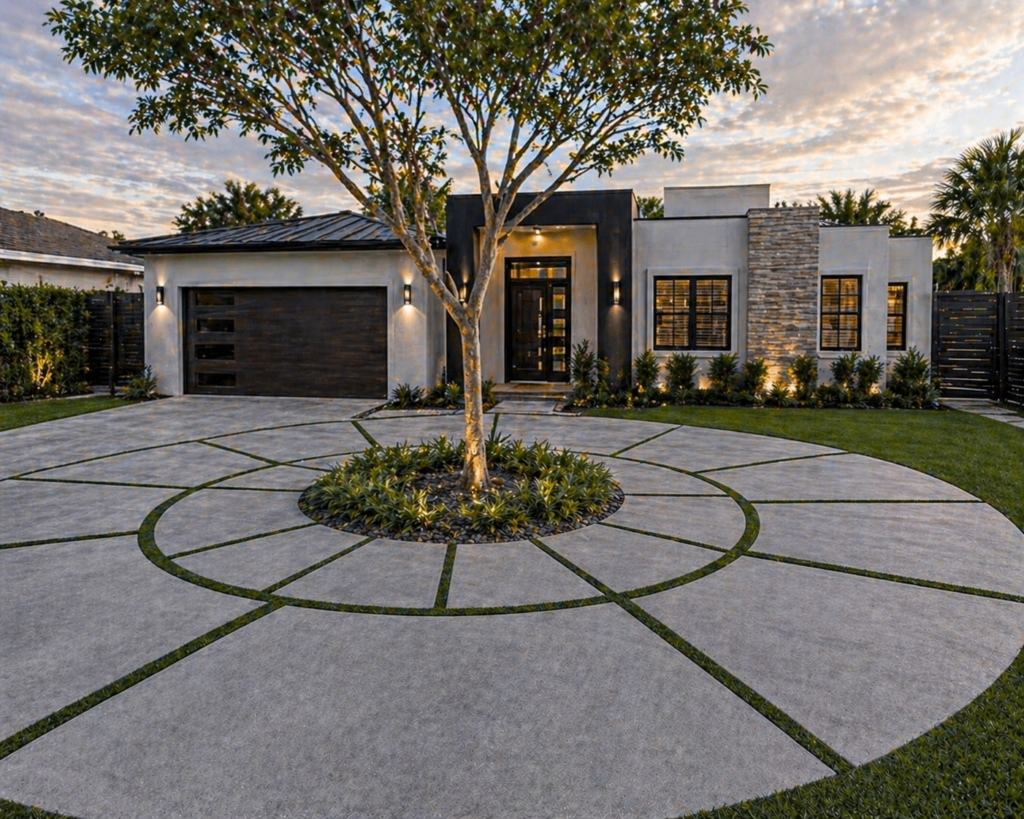
TL;DR: Paver driveway installation in Miami costs $8–$25 per square foot, with a typical 400 sq ft two-car driveway running $3,200–$10,000 including materials, labor, and permits. Hurricane-rated pavers meeting Miami-Dade’s 150+ mph wind standards add $2–$4/sq ft but provide essential storm protection. Budget for 2–4 weeks total timeline including permit approval, and expect coral rock excavation to add $3–$8/sq ft in eastern Miami-Dade neighborhoods.
How Much Does Paver Driveway Installation Cost in Miami?
When Hurricane Andrew devastated South Florida in 1992, it damaged or destroyed more than 125,000 homes and exposed critical weaknesses in construction standards. Today, Miami-Dade County enforces some of the nation’s strictest building codes – requirements that directly impact your paver driveway project costs.
Many Miami homeowners install a new paver driveway as part of a larger complete home remodeling project designed to improve both curb appeal and overall property value.

While paver driveways provide strong curb appeal returns, many homeowners maximize resale value by combining exterior improvements with kitchen remodeling in Miami, which remains one of the highest-ROI interior renovation projects.
Professional paver installation throughout South Florida typically costs between $8 and $25 per square foot, according to Deck & Drive’s 2024 analysis. For a standard 400 sq ft two-car driveway, you’re looking at $3,200–$10,000 total investment. Homeyou’s data from 612 completed Miami projects shows the average installation costs $4,105–$4,306, with pricing valid through July 2026.
The wide cost range reflects material choices and installation complexity. Basic concrete pavers start at $8–$14/sq ft installed, while premium travertine reaches $18–$25/sq ft. Miami labor rates average $58/hour, higher than Florida’s state average due to our specialized hurricane code requirements.
Here’s how costs break down for common driveway sizes:
| Driveway Size | Square Footage | Cost Range (Installed) |
|---|---|---|
| Single car | 200–250 sq ft | $1,600–$6,250 |
| Standard two-car | 400–500 sq ft | $3,200–$12,500 |
| Large with parking | 800–1,000 sq ft | $6,400–$25,000 |
Miami-Dade County requires permits for most driveway work, adding $150–$400 to your project. Drainage permits cost an additional $125–$300 if you’re increasing impervious surface area by more than 500 sq ft. Factor in these regulatory costs early – they’re non-negotiable in our hurricane zone.
Key Takeaway: Miami paver driveways cost $8–$25/sq ft installed, with 400 sq ft projects averaging $3,200–$10,000. Permit fees add $275–$700, and hurricane-rated materials increase costs by $2–$4/sq ft but provide essential storm protection.
What Factors Affect Paver Driveway Costs in Miami-Dade?
Miami’s unique geology and climate create cost factors you won’t find in generic Florida pricing guides. The coral rock substrate underlying much of eastern Miami-Dade requires specialized excavation equipment, while our position in Wind Zone 1 demands hurricane-rated materials and installation methods.
Material Costs: Concrete vs Travertine vs Clay Pavers
Material selection drives the largest cost variation in your project. Concrete pavers cost $3–$6 per square foot for materials alone, making them the most budget-friendly option. These meet ASTM C936 standards required by Miami-Dade Building Code and perform well in our subtropical climate.
Travertine pavers occupy the premium tier at $12–$20/sq ft for materials. Miami’s Port of Miami provides import advantages for Turkish travertine, but you’re still paying significantly more than concrete. The natural stone offers superior heat reflection – critical for barefoot comfort in our 90°F summers – and develops a desirable patina over time.
Clay pavers fall in the middle range at $8–$15/sq ft. These traditional brick pavers provide excellent durability and color retention, though they’re less common in Miami than concrete or travertine options.
Installation labor adds $5–$15/sq ft regardless of material choice, though complex patterns or premium materials may push labor costs toward the higher end. Angi’s 2025 data shows most Miami pros charge $50–$80 per hour, translating to $5–$15/sq ft for installation work.
Labor Rates Across Miami-Dade Neighborhoods
Geographic location within Miami-Dade significantly impacts labor costs. Coral Gables projects average 15–20% higher than unincorporated areas due to strict historic preservation codes requiring Board of Architects review. Contractors factor in the additional compliance work and extended timelines when pricing Coral Gables jobs.
Coastal communities like Miami Beach and Key Biscayne command premium rates due to flood zone requirements and saltwater exposure considerations. Properties within one mile of saltwater need sealed pavers to prevent salt deterioration, adding $1–$2/sq ft to installation costs.
West Miami-Dade neighborhoods including Kendall, Westchester, and Fontainebleau show labor rates $2–$4/sq ft lower than coastal areas. Greater contractor competition and lower overhead costs in these established residential areas create pricing advantages for homeowners.
South Miami-Dade areas like Homestead show the county’s lowest labor rates at $6–$10/sq ft, reflecting different market dynamics and fewer high-end projects. However, you’ll want to verify contractor licensing and insurance carefully in this price range.
Luxury properties often benefit from coordinated renovations that include driveways, kitchens, bathrooms, flooring, and interior upgrades as part of a larger whole-home remodeling strategy.Base Preparation and Drainage Costs
South Florida’s high water table – often just 2–4 feet below surface – requires careful drainage planning that adds $800–$2,500 to most projects. The South Florida Water Management District’s hydrogeologic data confirms our unique challenge: heavy seasonal rainfall combined with shallow groundwater creates standing water risks without proper drainage systems.
The necessary clearing and leveling required to prepare the site for your paver installation will typically cost anywhere from $1,000 to $3,000, according to Deck & Drive’s South Florida analysis. This includes excavation, grading, and installing a minimum 4-inch compacted gravel base essential for Miami’s conditions.
Coral rock excavation in eastern Miami-Dade adds $3–$8/sq ft compared to standard soil excavation. The oolitic limestone substrate requires hydraulic breakers or rock saws – specialized equipment that increases both time and cost. Western Miami-Dade areas including Kendall and Doral sit on deeper soil deposits, reducing excavation difficulty and costs by 30–50%.
French drains or channel drain systems add $800–$2,500 depending on driveway size and drainage complexity. These aren’t optional extras in Miami – they’re essential infrastructure preventing water intrusion and base erosion during our May–October rainy season, when monthly rainfall averages 7.5 inches.
When homeowners are already investing in major property improvements, combining exterior upgrades with bathroom remodeling in Miami can often create a more cohesive renovation plan while reducing long-term construction disruptions.Key Takeaway: Material choice ($3–$20/sq ft), neighborhood location (15–20% premium in Coral Gables), and coral rock excavation ($3–$8/sq ft in eastern Miami-Dade) create the largest cost variations. Proper drainage systems ($800–$2,500) are non-negotiable in our high water table environment.
Miami Paver Driveway Cost Breakdown by Size
Project size creates economies of scale that reduce per-square-foot costs on larger driveways. Understanding these pricing tiers helps you budget accurately and identify when expanding your project scope might deliver better value.
Single-car driveways (200–250 sq ft) cost $1,600–$6,250 installed, with the wide range reflecting material choices. A basic concrete paver installation at $8/sq ft totals $1,600–$2,000, while premium travertine at $25/sq ft reaches $5,000–$6,250. These smaller projects don’t benefit from bulk material discounts or installation efficiencies.
Standard two-car driveways (400–500 sq ft) represent the most common Miami residential project. Costs average $3,200 to $12,500 depending on material selection and complexity. At this size, you’ll see per-square-foot costs drop 10–15% compared to smaller projects as contractors achieve better material pricing and installation efficiency.
Here’s a detailed cost breakdown for a typical 400 sq ft driveway:
| Cost Component | Amount | Per Sq Ft |
|---|---|---|
| Concrete pavers (materials) | $1,200–$2,400 | $3–$6 |
| Labor (installation) | $2,000–$6,000 | $5–$15 |
| Base preparation | $800–$1,600 | $2–$4 |
| Permits and fees | $275–$700 | $0.69–$1.75 |
| Total | $4,275–$10,700 | $10.69–$26.75 |
Large driveways with parking areas (800–1,000 sq ft) cost $6,400–$25,000 installed. Per-square-foot costs drop another 10–15% at this scale due to efficiency gains. A 1,000 sq ft concrete paver driveway might cost $8,000–$12,000 ($8–$12/sq ft), while the same size in travertine reaches $18,000–$25,000 ($18–$25/sq ft).
The economies of scale become significant above 600 sq ft. Material suppliers offer better pricing on larger orders, and installation crews work more efficiently on expansive projects. If you’re considering a driveway expansion or adding parking areas, combining the work into a single project typically saves 15–20% compared to phasing the work.
Key Takeaway: Single-car driveways (200–250 sq ft) cost $1,600–$6,250, standard two-car (400–500 sq ft) run $3,200–$12,500, and large driveways (800–1,000 sq ft) range $6,400–$25,000. Per-square-foot costs drop 10–15% at each size tier due to efficiency gains.
What Permits Do You Need for Paver Driveway Installation in Miami?
Miami-Dade County’s permit requirements reflect our hurricane vulnerability and strict building codes. Understanding the permit process prevents costly delays and ensures your installation meets code requirements that protect your investment during storm events.
Right-of-way permits are required for any driveway work affecting the public right-of-way, with fees ranging from $150 to $400 based on scope. This covers the curb cut and any work within the county-controlled area between your property line and the street. Standard applications are processed within 5–10 business days, or you can pay an additional $100 for expedited 3-day turnaround.
Building permits are required for new driveway construction or substantial reconstruction exceeding 200 square feet in unincorporated Miami-Dade County. Permit fees range $75–$250 based on construction valuation. Incorporated municipalities including City of Miami, Coral Gables, and Pinecrest have separate permit requirements – verify with your local building department.
Drainage permits add another layer when you’re increasing impervious surface area by more than 500 sq ft. Miami-Dade requires drainage review and permits costing $125–$300 to prevent flooding. Larger driveways may need engineered drainage plans, adding professional engineering fees of $500–$1,500.
HOA architectural review timelines vary dramatically by community. Florida law requires HOAs to respond within 30 days, but this doesn’t prevent multiple revision requests. Standard communities process approvals in 2–3 weeks, while historic preservation districts like Coral Gables can extend to 6 weeks or more. Coral Gables requires Board of Architects review for all exterior modifications, adding 4–6 weeks and $500–$1,500 in review fees.
Contractor licensing verification is your responsibility as the homeowner. Verify your contractor holds a valid Miami-Dade County contractor license and carries required insurance. The county’s online license verification system lets you confirm active status and check for violations or complaints.
Final inspection scheduling adds 3–5 days after installation completion. Inspections must be requested 24 hours in advance, with typical scheduling within 2–3 business days. Your contractor should handle inspection coordination, but verify this is included in your contract.
Key Takeaway: Budget $275–$700 for permits (right-of-way $150–$400, building $75–$250, drainage $125–$300). Total timeline including permits runs 2–4 weeks, extending to 4–8 weeks with HOA approvals in communities like Coral Gables.
How to Choose Hurricane-Rated Pavers for Miami Driveways
Miami-Dade County sits in Wind Zone 1 – the nation’s highest hurricane risk category requiring design for sustained winds of 150 mph or greater. Your paver selection and installation method must meet these standards to pass inspection and protect your investment during storm events.
ASTM C936 standards specify minimum requirements for interlocking concrete paving units used in residential applications. This covers dimensional tolerances, compressive strength, and durability requirements. Miami-Dade Building Code Section 1609.1.1 references these standards as baseline requirements for all exterior hardscape products.
Paver thickness matters significantly in hurricane zones. While 60mm (2.36 inch) pavers meet minimum standards for light vehicular traffic, 80mm (3.15 inch) thickness is recommended for South Florida to prevent cracking and displacement during high winds. The thicker pavers cost $1–$2/sq ft more than 60mm options but provide substantially better hurricane performance.
Interlocking paver designs provide superior wind uplift resistance through mechanical connection between units. Post-hurricane field assessments following Hurricane Irma (2017) and Ian (2022) showed interlocking pavers experienced significantly less displacement than non-interlocking designs in the same wind zones.
Miami-Dade Product Control requires Notice of Acceptance (NOA) for all building products used in the county. This is the most stringent product approval process in the United States, involving rigorous testing for hurricane performance. Verify your chosen pavers have current Miami-Dade NOA approval – your contractor should provide this documentation.
Hurricane-rated edge restraints add $1.50–$3.00 per linear foot compared to standard plastic edging. Concrete or metal edge restraint systems designed for hurricane wind resistance prevent the perimeter displacement that often initiates larger paver failures during storms. This isn’t an area to economize – proper edge restraints are essential for system integrity.
The total premium for hurricane-rated paver systems adds approximately $2 to $4 per square foot to installation costs. This covers thicker pavers, upgraded edge systems, and additional installation labor for proper mechanical connection. For a 400 sq ft driveway, you’re investing an extra $800–$1,600 for storm protection that could save tens of thousands in post-hurricane repairs.
When evaluating contractors, ask specifically about their hurricane code compliance experience. Local providers like Fab’s Construction & Remodeling understand Miami-Dade’s unique requirements and can guide you through product selection that meets both aesthetic goals and code requirements.
Key Takeaway: Hurricane-rated pavers meeting ASTM C936 and Miami-Dade NOA requirements add $2–$4/sq ft but provide essential 150+ mph wind protection. Specify 80mm thickness ($1–$2/sq ft premium) and hurricane-rated edge restraints ($1.50–$3/linear ft) for optimal storm performance.
Miami Paver Driveway Installation Timeline and Process
Weather patterns and permit requirements create timeline considerations unique to South Florida. Understanding the complete process helps you schedule work during optimal conditions and set realistic expectations for project completion.
Total timeline from permit application to final inspection approval ranges from 2 to 4 weeks for straightforward installations. This extends to 4–8 weeks when HOA approvals are required in communities with architectural review boards. Coral Gables projects face the longest timelines due to historic preservation requirements.
Permit approval takes 5–10 business days for standard right-of-way and building permits. Drainage permits may require additional time if engineered plans are needed. Submit all permit applications simultaneously to avoid sequential delays – your contractor should coordinate this process.
A typical residential driveway installation takes 3 to 5 days of actual work, according to Pavers and Tiles’ installation data. This breaks down into excavation and base preparation (2–3 days), paver installation and compaction (1–2 days), and finishing work (1 day). Coral rock excavation in eastern Miami-Dade can extend the excavation phase by 1–2 days.
Miami’s rainy season from May through October creates scheduling challenges. Monthly rainfall averages 7.5 inches during wet season, with June seeing 9.4 inches on average. Contractors charge 10–15% premiums for wet season work due to weather-related scheduling uncertainty and potential project extensions. Some refuse wet season work entirely.
November through April provides optimal installation conditions with minimal weather delays and faster curing times. Dry season averages just 2.5 inches monthly rainfall, allowing consistent work schedules. If your timeline is flexible, scheduling for dry season installation saves money and reduces weather-related delays.
Final inspection scheduling adds 3–5 days after installation completion. Your contractor requests inspection 24 hours in advance, with typical scheduling within 2–3 business days. The inspector verifies proper base preparation, correct paver installation, adequate drainage, and compliance with approved plans.
Weather delays during installation can extend timelines by 3–6 weeks during rainy season. A single afternoon thunderstorm doesn’t typically delay work, but multi-day rain events prevent base preparation and paver installation. Factor this uncertainty into your planning if scheduling during May–October.
Key Takeaway: Complete projects take 2–4 weeks from permit to final approval, with actual installation requiring 3–5 days. Schedule November–April for optimal conditions and 10–15% cost savings versus rainy season premiums. HOA approvals add 2–6 weeks in communities like Coral Gables.
Ways to Reduce Paver Driveway Installation Costs in Miami
Strategic planning and informed material choices can reduce your project costs by 20–30% without compromising quality or code compliance. Understanding where to economize – and where not to – protects your investment while managing budget.
Material selection offers the most significant savings opportunity. Concrete pavers at $8–$14/sq ft installed cost 40–50% less than travertine at $18–$25/sq ft. For a 400 sq ft driveway, choosing concrete over travertine saves $4,000–$4,400. Concrete pavers meeting ASTM C936 standards perform excellently in Miami’s climate and meet all hurricane code requirements.
Off-season installation during November–March delivers 10–15% savings compared to peak season pricing. Contractors have more scheduling flexibility during dry season and don’t charge weather delay premiums. A $10,000 project saves $1,000–$1,500 simply by scheduling during optimal months.
Pattern complexity affects labor costs significantly. Running bond or herringbone patterns install efficiently, while circular patterns or intricate designs add 0.5–1 day of labor. Choosing standard patterns over custom designs saves $200–$800 on a typical driveway without compromising appearance or performance.
Financing options through local contractors can spread costs over time without interest. Deck & Drive offers no change order guarantees, meaning the quoted price is final – no surprise costs mid-project. This pricing transparency helps budget planning and prevents cost overruns.
DIY edge restraint installation isn’t recommended in Miami’s hurricane zone. Proper edge restraint installation requires specific techniques for wind resistance, and improper installation voids warranties while creating code compliance issues. The $600–$1,200 you might save on DIY edge work isn’t worth the risk in Wind Zone 1.
What not to cheap out on: base preparation and drainage. Cutting corners on the 4-inch compacted gravel base or eliminating proper drainage systems creates expensive failures within 2–3 years. Miami’s high water table and heavy rainfall make proper base preparation and drainage non-negotiable for long-term performance.
Combining projects delivers economies of scale. If you’re planning both driveway and patio work, scheduling them together saves 15–20% compared to separate projects. Material suppliers offer better pricing on larger orders, and installation crews work more efficiently on combined projects.
Key Takeaway: Choose concrete over travertine (40–50% savings), schedule November–March (10–15% discount), and select standard patterns over custom designs ($200–$800 savings). Never economize on base preparation or drainage – these are essential for Miami’s climate conditions.
Recommended Local Paver Installation Services
Finding a qualified contractor who understands Miami-Dade’s unique requirements – from hurricane codes to coral rock excavation – is essential for a successful project. Local expertise matters significantly when navigating permit requirements and ensuring code compliance.
Fab’s Construction & Remodeling serves Miami-Dade County with comprehensive paver installation services that address our region’s specific challenges. Their team understands the nuances of working in different neighborhoods, from Coral Gables’ historic preservation requirements to Miami Beach’s flood zone considerations.
When evaluating contractors, verify these essential qualifications:
- Active Miami-Dade contractor license with clean compliance record
- Comprehensive insurance including general liability and workers’ compensation
- Hurricane code expertise with NOA-approved product knowledge
- Local project portfolio showing work in your specific neighborhood
- Transparent pricing with detailed written estimates and no-surprise guarantees
Licensed contractors understand Miami-Dade’s permit requirements and handle the application process efficiently. They know which products have current NOA approval and can guide material selection that meets both aesthetic goals and code requirements. This local knowledge prevents costly mistakes and ensures your installation passes inspection on the first attempt.
Request references from projects in your neighborhood. Installation challenges vary significantly between eastern Miami-Dade’s coral rock substrate and western areas’ deeper soil deposits. A contractor experienced in your specific area understands the geological and regulatory factors affecting your project.
Verify warranty coverage before signing contracts. Material warranties from manufacturers typically run 25 years to lifetime, but installation workmanship warranties vary from 1–5 years. ICPI-certified contractors must offer minimum 1-year installation warranties covering settling, joint sand loss, and installation defects.
Key Takeaway: Choose licensed contractors with Miami-Dade hurricane code expertise and neighborhood-specific experience. Verify NOA product knowledge, transparent pricing, and comprehensive warranties. Local providers like Fab’s Construction & Remodeling understand our unique requirements from permits to coral rock excavation.
Frequently Asked Questions
How much does a 400 sq ft paver driveway cost in Miami?
Direct Answer: A 400 sq ft paver driveway in Miami costs $3,200–$10,000 installed, depending on material choice and site conditions.
Homeyou’s analysis of 612 Miami projects shows average costs of $4,105–$4,306 for standard installations. Concrete pavers at the lower end ($8–$14/sq ft) total $3,200–$5,600, while premium travertine ($18–$25/sq ft) reaches $7,200–$10,000. Add $275–$700 for permits and $800–$2,500 for drainage systems if required.
Do I need a permit for paver driveway installation in Miami-Dade?
Direct Answer: Yes, most paver driveway projects in Miami-Dade require right-of-way permits ($150–$400) and building permits ($75–$250) for work exceeding 200 sq ft.
Miami-Dade County requires permits for any driveway work affecting public right-of-way. Building permits are mandatory for new construction or substantial reconstruction over 200 sq ft in unincorporated areas. Incorporated municipalities have separate requirements – verify with your local building department. Drainage permits ($125–$300) are required when increasing impervious surface by more than 500 sq ft.
What’s the cost difference between concrete and travertine pavers in Miami?
Direct Answer: Concrete pavers cost $8–$14/sq ft installed versus travertine at $18–$25/sq ft – a 55–80% price premium for natural stone.
For a 400 sq ft driveway, concrete totals $3,200–$5,600 while travertine reaches $7,200–$10,000. Both materials meet Miami-Dade hurricane codes when properly installed. Travertine offers superior heat reflection and develops an attractive patina, but concrete provides excellent performance at significantly lower cost. Material warranties are similar (25 years to lifetime), so the choice comes down to budget and aesthetic preference.
How long does paver driveway installation take in South Florida?
Direct Answer: Actual installation takes 3–5 days, but total timeline including permits runs 2–4 weeks (4–8 weeks with HOA approvals).
Permit approval requires 5–10 business days. Installation breaks down into excavation and base preparation (2–3 days), paver installation (1–2 days), and finishing (1 day). Coral rock excavation in eastern Miami-Dade adds 1–2 days. Final inspection scheduling adds 3–5 days. Weather delays during May–October rainy season can extend timelines by 3–6 weeks.
Are pavers or asphalt driveways cheaper in Miami?
Direct Answer: Asphalt costs less initially ($2–$5/sq ft) versus pavers ($8–$25/sq ft), but 20-year total ownership costs are comparable.
Asphalt driveways in Florida cost $2–$5 per square foot for initial installation. However, asphalt requires resurfacing every 10–15 years at $2–$4/sq ft and doesn’t perform as well in Miami’s heat. Pavers last 25–50 years with minimal maintenance (re-sanding joints every 2–3 years at $0.50–$1.50/sq ft). Individual paver replacement is possible; asphalt requires full-section repair.
What paver thickness do I need for Miami hurricane codes?
Direct Answer: While 60mm (2.36 inch) pavers meet minimum code, 80mm (3.15 inch) thickness is recommended for Miami-Dade’s Wind Zone 1 requirements.
Miami-Dade Building Code requires pavers meeting ASTM C936 standards for 150+ mph sustained winds. The 80mm thickness provides better wind uplift resistance and prevents cracking during storm events. The upgrade costs $1–$2/sq ft more than 60mm pavers but delivers substantially better hurricane performance. Verify your chosen pavers have current Miami-Dade NOA approval.
Can I install pavers over existing concrete driveway in Miami?
Direct Answer: Yes, but only if the existing concrete is structurally sound, level, and properly draining – reducing installation costs by $2–$4/sq ft.
Installing pavers over concrete eliminates excavation and base preparation costs. However, the existing slab must be crack-free, level within 1/4 inch per 10 feet, and have adequate drainage. Miami’s high water table makes proper drainage critical. Most contractors recommend this approach only for concrete in excellent condition. Poor underlying concrete will cause paver failure within 2–3 years.
How much does HOA approval add to paver driveway timeline?
Direct Answer: HOA architectural review adds 2–6 weeks depending on community requirements, with historic districts like Coral Gables taking longest.
Florida law requires HOAs to respond within 30 days, but multiple revision requests can extend timelines. Standard communities process approvals in 2–3 weeks. Coral Gables requires Board of Architects review for all exterior modifications, adding 4–6 weeks and $500–$1,500 in review fees. Submit HOA applications simultaneously with permit applications to avoid sequential delays.
Planning a paver driveway installation in Miami requires understanding our unique combination of hurricane codes, coral rock geology, and permit requirements. The $8–$25/sq ft cost range reflects material choices and installation complexity, with hurricane-rated systems adding essential storm protection for $2–$4/sq ft premium.
Budget 2–4 weeks for complete project timelines including permits, extending to 4–8 weeks with HOA approvals in communities with architectural review requirements. Schedule installation during November–April dry season for optimal conditions and 10–15% cost savings versus rainy season premiums.
Choose licensed contractors with Miami-Dade hurricane code expertise and neighborhood-specific experience. Verify NOA product knowledge, transparent pricing, and comprehensive warranties. Never economize on base preparation or drainage – these are essential for long-term performance in our high water table environment.
Ready to start your paver driveway project? Contact Fab’s Construction & Remodeling for a detailed estimate that addresses your specific site conditions and neighborhood requirements.
Ready to Get Started?
If you’re already planning major improvements to your property, Fab’s Construction & Remodeling also specializes in complete home remodeling throughout Miami-Dade County, including kitchen renovations, bathroom remodeling, structural redesigns, and full interior transformations.